 ultimate-guide
Commercial Grade Christmas Lights for Business: 2026 Guide
Last Updated: October 23, 2026
Quick Summary
Commercial grade christmas lights are built to survive repeated seasonal installation, harsh weather, and continuous nightly operation, using heavier conductors, replaceable bulbs, and weather-sealed sockets instead of consumer-grade components. Specify a UL listing for wet locations, adequate wire gauge, and replaceable parts, and plan your electrical load before ordering.
- Commercial C9 stringers typically use 18-gauge wire and are sold by the spool so runs can be cut to fit.
- Add 10-15% to measured linear feet for sag and termination, and order spare bulbs at 5-10% of installed count.
- A 20-amp circuit is rated for 2,400 watts, but keep continuous load at or below roughly 1,920 watts.
- Label each spool by building zone so next year's installation is a repeat rather than a redesign.
- Compare options by annualized cost: total cost divided by the seasons the product realistically survives.
Table of Contents
- Why Commercial Grade Christmas Lights Matter for Business Properties
- Commercial Outdoor Christmas Lights: What to Look For
- Commercial Grade C9 Christmas Lights: Bulbs, Stringers, and Spools
- Commercial Christmas Lights Wholesale: Procurement and Quantity Planning
- Electrical Load, Circuit Planning, and Safety
- Total Cost of Ownership: Lights, Installation, and ROI
- Commercial Christmas Light Maintenance and Storage
- Frequently Asked Questions
Why Commercial Grade Christmas Lights Matter for Business Properties
Commercial grade Christmas lights for business are lighting products built to survive repeated seasonal installation, harsh weather, and continuous nightly operation, rather than a single holiday season on a house.
The difference is not marketing language. Consumer light sets use thin wire, sealed bulb bases, and plastic housings that crack after one or two winters.
Below, we break down what to specify, how to plan quantity and electrical load, and how to calculate what a display actually costs over several seasons.
Commercial Outdoor Christmas Lights: What to Look For
Commercial outdoor Christmas lights are defined by three specifications: a UL listing for wet locations, wire gauge heavy enough for the run length, and replaceable components. Miss any one and you have bought a consumer product in commercial packaging.
Weather-Resistant Construction and UL Ratings
Look for a UL listing appropriate to outdoor, wet-location use on the tag, not just "indoor/outdoor" printed on the box. Sealed sockets, molded plugs, and UV-stabilized insulation are what keep water out of the contacts. On a roofline, water intrusion at the socket is the most common cause of a dead section mid-season.
LED vs Incandescent for Business Displays
LED is the default for business displays. LEDs draw a fraction of the current of incandescent lamps, which lets you run far more light on a single circuit, and they hold their color without the warm-up fade that incandescent filaments show in cold weather. Incandescent still has a place: some property owners prefer its warmer glow and softer falloff. Our take is that incandescent only makes sense for small, close-viewed accents where the electrical load is trivial.
Commercial Grade C9 Christmas Lights: Bulbs, Stringers, and Spools
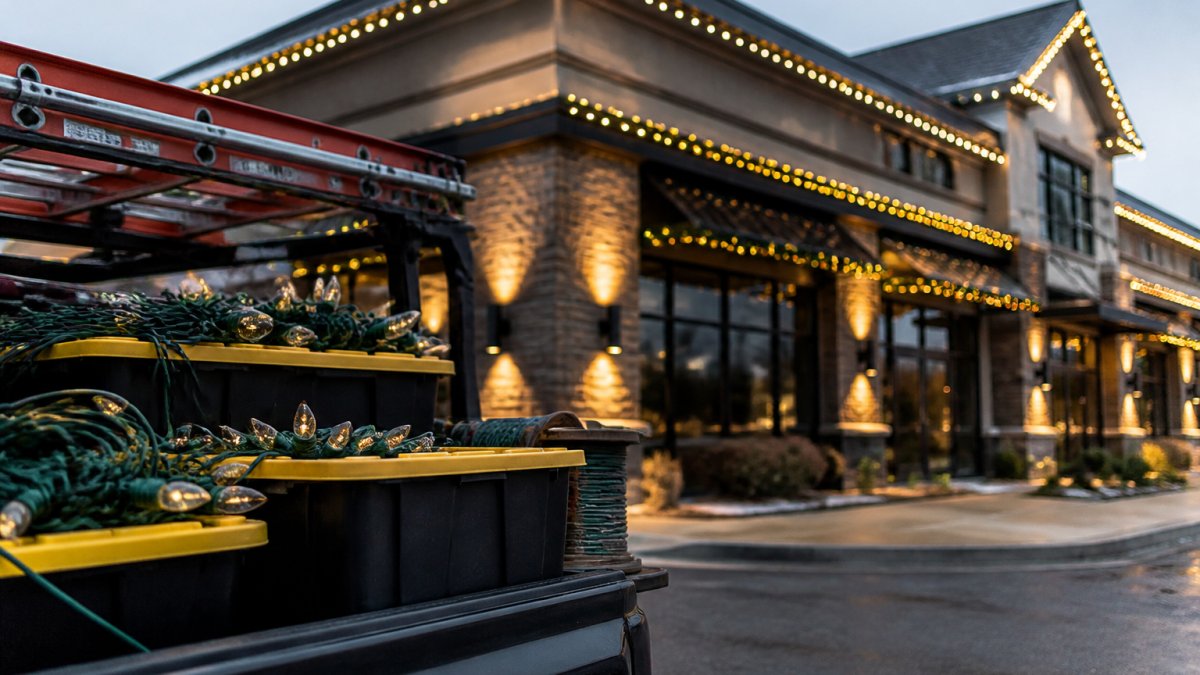
Commercial grade C9 Christmas lights are the workhorse of roofline and tree lighting: a C9 bulb seated in a socket on a stringer, sold by the spool so you can cut and terminate runs to fit the building.
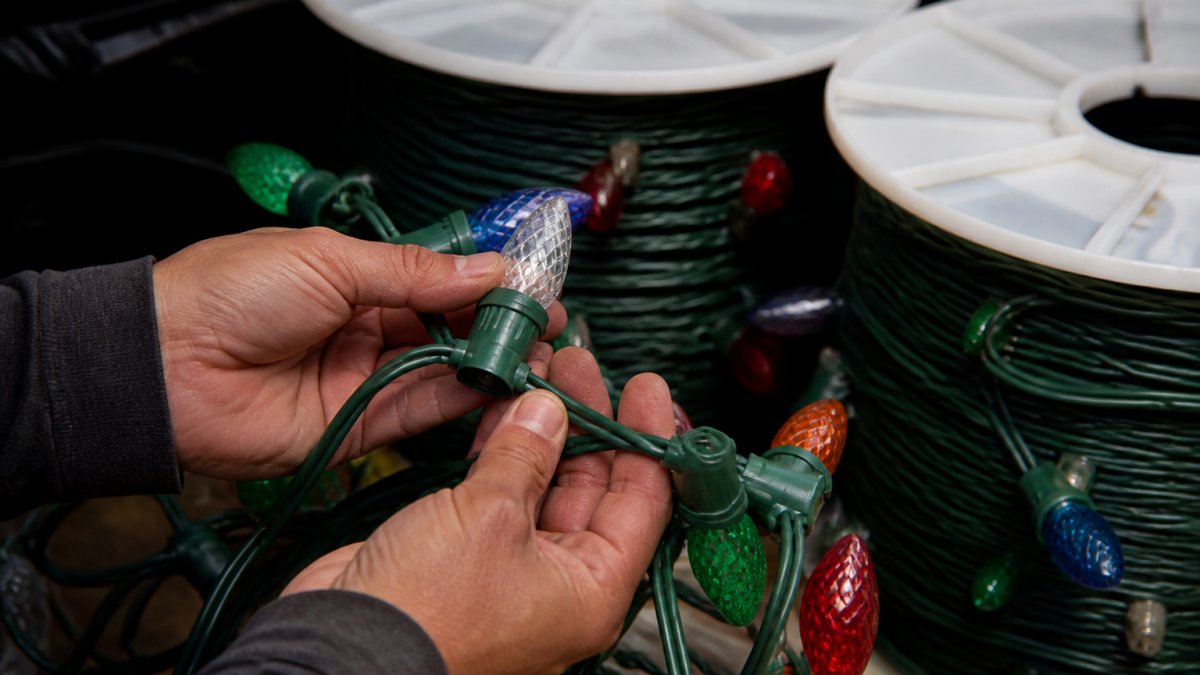
The components you are actually buying:
- Stringers: the wire and socket assembly, sold on bulk spools or in fixed light sets, typically on 18-gauge wire for commercial runs
- Sockets: the receptacles that hold each bulb; commercial sockets are replaceable and weather-sealed
- Bulbs: sold separately in most commercial lines, so one failed lamp costs one lamp
Bulb Shapes, Colors, and Finishes
Beyond C9, the common commercial shapes are C7 for smaller roofline accents, C6 for dense tree wrapping, and wide-angle conical lights for even coverage on large facades. Mini lights and net lights handle shrubs and greenery; net lights are the fastest way to cover a hedge evenly. Finishes run from clear and warm white through multicolor and colored lamps, with faceted and smooth options changing how the light reads at distance.
Commercial Christmas Lights Wholesale: Procurement and Quantity Planning
Commercial Christmas lights wholesale purchasing works on a simple principle: buy by the spool and by the case, not by the retail box, and buy enough spare lamps to service the display without a second order.
Work through this checklist before you order:
- Measure every roofline, eave, and ridge in linear feet, then add 10-15% for sag and termination
- Count trees and estimate wrap height and trunk circumference for each
- Decide bulb spacing per foot, since spacing drives total bulb count
Pricing depends on quantity, bulb type, and lead time, so request a quote rather than working from list prices. Order early: commercial stock tightens as the season approaches, and a late order limits your color and shape options.
Electrical Load, Circuit Planning, and Safety
Electrical load planning is the step most business buyers skip, and it is the one that decides whether the display runs all season or trips a breaker in week two. The good news is that the math is simple once you know the inputs: watts per lamp, lamps per stringer, stringers per circuit, and the circuit's safe capacity.
Start With Watts, Not Strings
Every lighting plan should begin with a wattage tally. Multiply the wattage of each lamp by the number of lamps on the run, then add the runs together per circuit. LED lamps draw a small fraction of what incandescent lamps draw, which is why a single 20-amp, 120-volt circuit can carry a large LED display but only a modest incandescent one.
Work through the plan in this order:
- Tally the load per zone. List every stringer by building zone and note its lamp count and wattage.
- Convert to amps. Divide total watts by 120 volts to get the amperage the zone will draw.
- Assign zones to circuits. Keep each circuit under the 80% continuous-load threshold and leave one spare circuit for future expansion.
- Check voltage drop on long runs. The farther a run travels from the power source, the more the voltage sags and the dimmer the far-end lamps become. Heavier wire and shorter runs reduce the drop; the manufacturer's maximum run length exists for this reason.
- Confirm GFCI protection. Every outdoor circuit should be on ground-fault circuit interrupter protection, whether at the breaker or at an inline GFCI cord set.
Connections, Cord, and Cold-Weather Behavior
Connections are where most mid-season failures originate. Keep every plug connection off the ground and out of standing water, use cord sets rated for outdoor use, and never run extension cords through doorways, windows, or under mats where they can be pinched.
Cold weather changes the picture in two ways. First, resistance in conductors rises slightly, which can worsen voltage drop on marginal runs. Second, plastic housings and cord jackets get brittle, so handling during installation and removal should be gentler than in warm months.
When to Bring In a Licensed Electrician
Any new circuit, panel work, subpanel, or dedicated outdoor receptacle should be handled by a licensed electrician. The same goes for any display that will draw near the panel's capacity, any property with older wiring, and any install where the power source is far from the display area.
A simple load-planning worksheet, zone, lamp count, wattage, amps, circuit assignment, is the single most useful document a business can keep with its holiday lighting inventory. It turns next year's install into a repeat instead of a redesign.
Total Cost of Ownership: Lights, Installation, and ROI
Total cost of ownership is where commercial grade lights win the argument, but only if you actually run the numbers across the seasons a display will serve. A consumer set that costs less up front but fails after one or two seasons costs more per year than a commercial set that lasts several seasons with occasional bulb swaps, and that is before you count the labor to reinstall a failed string.
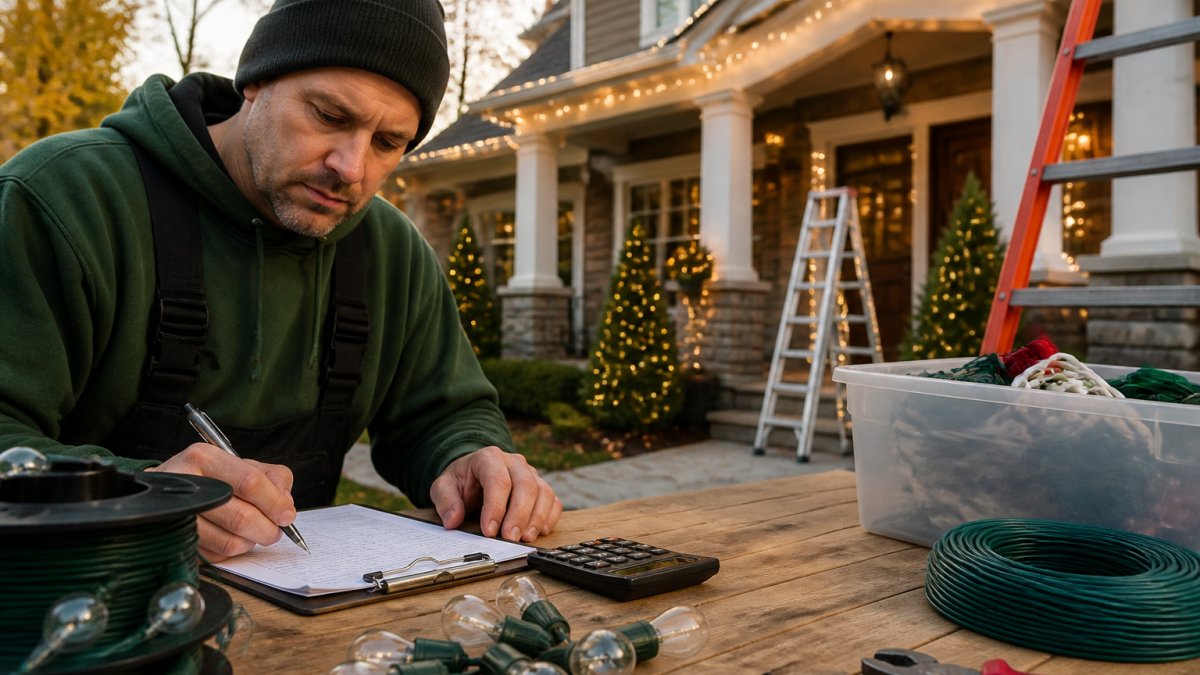
The ownership equation has six parts, and each one behaves differently for consumer versus commercial product:
- Product cost spread across the seasons the set actually survives. A commercial set that lasts five seasons spreads its purchase price across five years; a consumer set that lasts two spreads its price across two.
- Installation labor, which is roughly the same whether the product is cheap or durable. Labor is the largest line item for most commercial displays, and it is paid every season regardless of product quality, which is why durability matters more than sticker price.
- Energy cost, driven by lamp wattage and nightly run hours. LED displays cut this line dramatically versus incandescent, and the savings compound across a long season.
- Maintenance, driven by how many lamps and sockets fail mid-season. Replaceable bulbs and sealed sockets cut failures and let a single failed lamp be swapped instead of forcing a whole string to be replaced.
- Storage and handling, which determines whether the set survives to next year. Reels, labeled zones, and dry storage protect the investment; a tangled bin in a damp shed destroys it.
- Replacement and spare inventory, which is predictable when you buy spare lamps at 5-10% of installed count and unpredictable when you are reordering retail sets mid-season.
A Simple Way to Compare Two Scenarios
Rather than arguing about sticker price, compare annualized cost. Add product cost, installation labor, energy, maintenance, and storage for each option, then divide by the number of seasons the product realistically survives. Most business buyers find the commercial option wins on annualized cost even when its up-front price is higher, because the labor and replacement lines shrink so much. The comparison is most dramatic on large displays, where labor dominates the budget and a failed string means a lift trip.
Where the ROI Actually Shows Up
The financial case for holiday lighting is not only about cost, it is about what the display does for the business. A well-lit storefront, restaurant patio, or hotel entrance extends the hours the property reads as open and inviting, supports seasonal marketing and photography, and gives customers a reason to stop. For retail and hospitality properties, the display is part of the curb appeal that drives foot traffic during the highest-revenue weeks of the year.
That is also the case for a managed service. Handling design, installation, mid-season maintenance, removal, and organized storage in one program turns the display into a repeatable asset rather than a project rebuilt each year, and it keeps the labor, maintenance, and storage lines from creeping up season after season.
Commercial Christmas Light Maintenance and Storage
Commercial Christmas light maintenance and storage is a year-round discipline, not a January afterthought. The procedure that protects a display is straightforward: test, clean, label, and store by location.
A workable annual routine:
- Test at removal. Note dead sections and failed lamps while the display is still up so you know what to fix.
- Clean and dry. Wipe down stringers and let them dry fully before packing; moisture in storage corrodes sockets.
- Label by zone. Tag each spool or reel with the building zone it serves so next year's install is a repeat, not a redesign.
- Store off the floor. Use reels and sealed bins in a dry space, away from rodents and standing water.
- Bench-test before the season. Plug in and check every run before it goes back on the roof.
A commercial display is a multi-season asset, and it only pays off if the product, the electrical plan, and the storage routine all hold up. That is the gap between buying lights and running a display.
Frequently Asked Questions
What is the difference between commercial-grade and store-bought Christmas lights?
Commercial grade christmas lights use heavier 18-gauge wire, replaceable bulbs, and UL-rated weather-resistant sockets built to last multiple seasons. Store-bought sets typically use thinner wire, sealed bulbs that cannot be replaced, and lower weather tolerances. For a business exterior, commercial-grade strings handle longer runs, higher wattage, and wind and rain without failing mid-season. They also support consistent color across large displays, which matters for rooflines, trees, and yards visible to customers.
Where can businesses buy commercial-grade Christmas lights wholesale?
Businesses typically buy commercial Christmas lights wholesale through specialty lighting distributors, landscape and holiday lighting suppliers, and direct manufacturer programs. Wholesale pricing depends on quantity, bulb type, wire gauge, and order timing. Ordering in late summer or early fall usually gives better availability and pricing than waiting until November. Ask for UL-rated stringers, replaceable bulbs, and a warranty on sockets and wire before committing to a large order.
How many Christmas lights does a business need?
Quantity depends on the display coverage: rooflines, trees, branches, yards, and building exteriors each require different spacing. A common planning rule is to measure linear feet for rooflines and multiply by the desired bulb spacing, then add 20-30% for trees and landscape features. Commercial Christmas lights wholesale orders should also include spare bulbs and extra stringers. A professional lighting design walkthrough gives a more accurate count before you buy.
Are LED Christmas lights a good choice for commercial properties?
LED lights are the standard choice for commercial outdoor Christmas lights because they use far less power than incandescent, run cooler, and last longer. Lower wattage means more strings per circuit, which simplifies electrical planning for large-scale displays. LED colors hold up well in cold weather, and wide-angle conical styles give even coverage. The tradeoff is higher upfront cost, but the energy savings and multi-season lifespan usually offset it.
How should commercial Christmas lights be maintained and stored after the season?
Commercial Christmas light maintenance and storage should include inspection, cleaning, testing, and organized packing. After removal, check each string for damaged sockets, cracked bulbs, and worn wire, then label and coil strings loosely to prevent tangling. Store in a dry, climate-controlled space away from moisture and pests. Testing before storage saves time next season and reduces replacement costs. Many businesses use a white-glove service that handles removal, testing, and storage.
How do businesses choose between buying lights and hiring a professional installer?
Buying lights makes sense when a business has in-house labor, safe access equipment, and storage space. Hiring a professional installer suits businesses that need liability coverage, steep-roof capability, and mid-season maintenance. Professional installation usually includes design, electrical planning, removal, and storage, which reduces risk and staff time. Compare the total cost of ownership, not just the price of the lights, before deciding.