 blog
How to Choose Outdoor Lighting for Gated Communities
Last Updated: October 30, 2026
Quick Summary
The best gated community lighting is a standardized system, not a collection of fixtures: specify matching fixture families with one color temperature across the property, light the entrance approach lane and camera zones for even coverage, and plan controls and maintenance up front. Good gated community lighting also means shielding fixtures to prevent glare and light trespass.
- Light the approach lane evenly for at least the last 50 to 75 feet before the gate.
- Aim for a 3:1 or 4:1 uniformity ratio in camera identification zones.
- Pick one color temperature, commonly 2700K or 3000K, and hold it everywhere.
- Run a quarterly night audit and clean fixtures twice yearly.
- Solar fixtures suit paths and remote areas but not entrances or camera zones.
Table of Contents
- Why Gated Community Lighting Is a Different Job
- Gated Community Entrance Lighting: The First 30 Seconds
- Community Pathway Lighting That Keeps Walkers Safe
- Outdoor LED Lighting: The Practical Default for Shared Spaces
- Security, Cameras, and Access Control Lighting
- Commercial Outdoor Lighting Maintenance on a Community Scale
- Glare, Light Trespass, and Dark-Sky Compliance
- Requesting a Community Lighting Consultation
- Frequently Asked Questions
Why Gated Community Lighting Is a Different Job
Most outdoor lighting advice assumes one decision-maker, one budget, and one taste. A gated community has none of those. The best gated community lighting must satisfy a board, a property manager, residents with different schedules, and a nightly security plan.
You are not decorating a house. You are specifying shared infrastructure that must look consistent from the entrance to the last cul-de-sac, survive years of weather, and stay maintainable when the person who approved it moves away.
Shared Infrastructure, Shared Decisions
Every fixture in a common area is a shared asset, shared cost and shared risk. A homeowner can swap a bulb on a Saturday; a community has to schedule it, budget it, and assign responsibility.
That reality drives three practical rules:
- Choose fixture families, not one-off pieces, so replacements match years later
- Standardize color temperature across the whole property so nothing looks mismatched
- Assign one point of contact for maintenance before installation, not after
A community lighting plan that ignores these rules looks fine in month one and chaotic by year three.
Gated Community Entrance Lighting: The First 30 Seconds
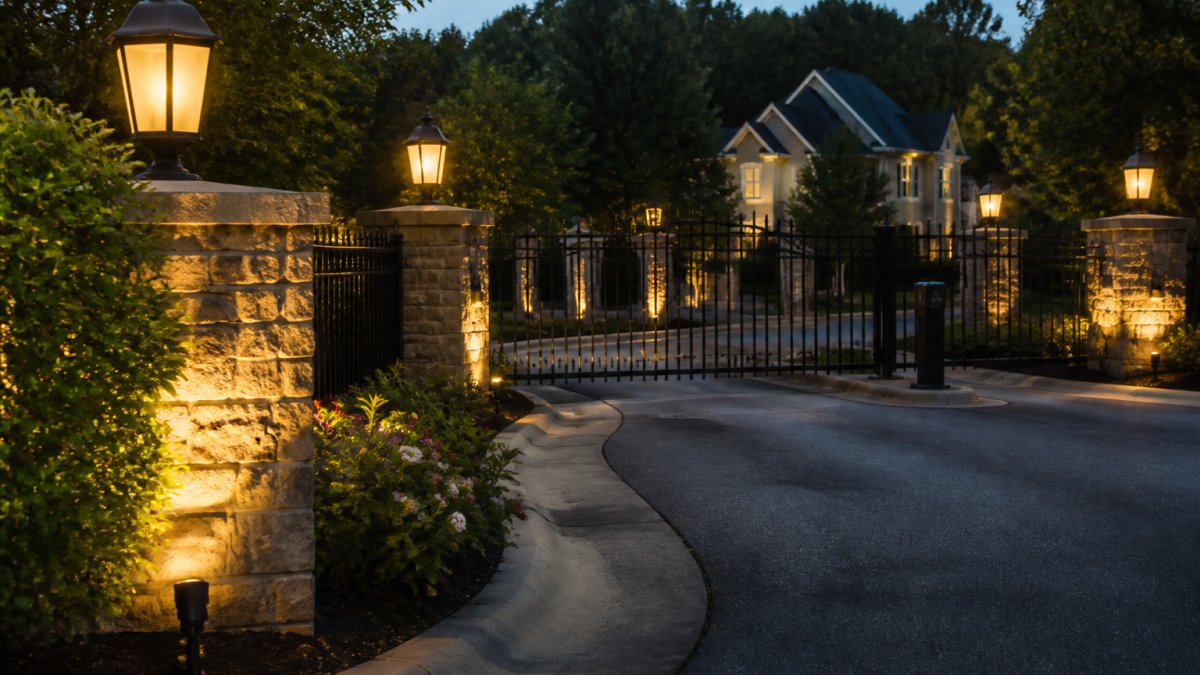
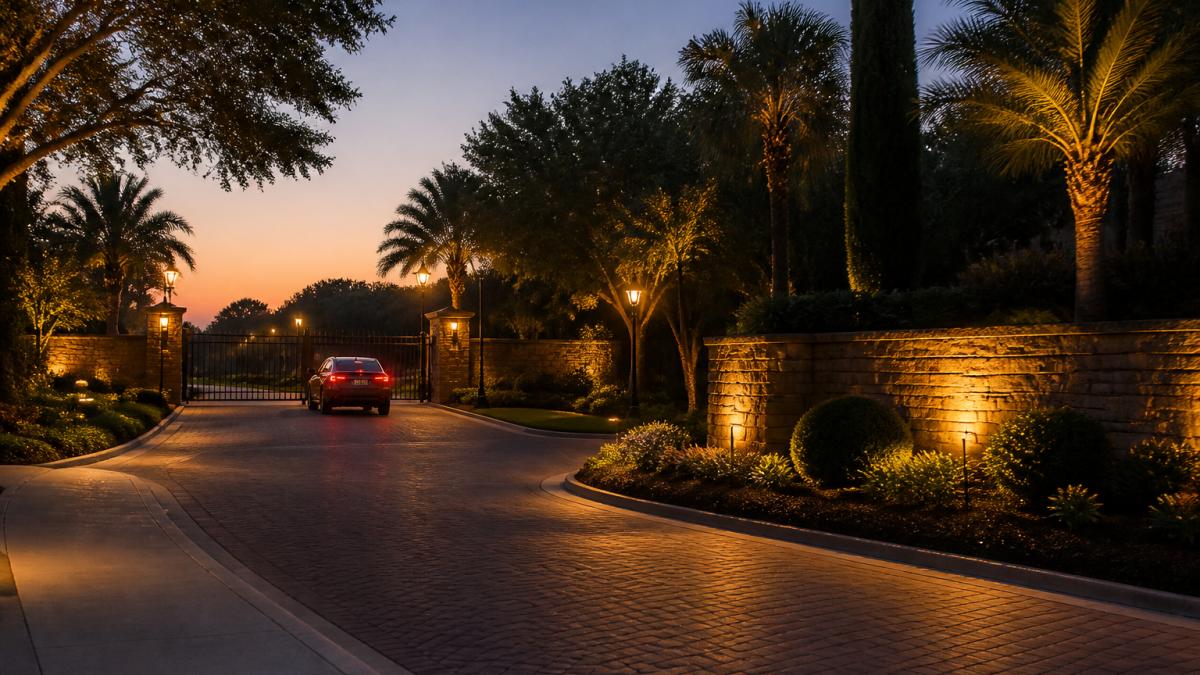
Gated community entrance lighting is the highest-value lighting on the property because it shapes every visitor's first impression and every camera's first frame.
Light the Approach Lane First
The most common failure is lighting the sign and gate while leaving the approach lane dark. A driver coming off an unlit street hits a wall of contrast, and the camera sees a blown-out plate against black. Establish a modest, even light level on the pavement for at least the last 50 to 75 feet before the gate.
Separate the Four Lighting Layers
The entrance corridor needs four layers working together, not three:
- Signage lighting makes the community name legible from the road, typically with narrow-beam uplights or dedicated sign fixtures aimed to avoid spill onto neighbors.
- Gate and pillar lighting defines the boundary without blinding drivers, shield the source, aim down and across, keep fixtures below eye height where possible.
- Ground-level pathway lighting carries pedestrians safely from the gate to the first homes and the keypad.
Design for the Camera, Not Just the Eye
Security cameras need uniformity more than intensity. A bright pool at the gate with deep shadow at the driver's window produces footage useless for identifying a face or plate. Coordinate with whoever manages access control so lighting and camera coverage are designed together.
Three camera-friendly rules:
- Keep the light source out of the camera's field of view, glare is the single biggest cause of unusable footage.
- Aim for consistent illumination across the frame; a 3:1 or 4:1 uniformity ratio is a reasonable working target for identification zones.
- Use a color temperature close to what the camera is white-balanced for; mismatched color casts wash out faces and plates.
Color Rendering Matters at the Gate
At an entrance, people need to recognize faces and read plates, not just see shapes. Choose fixtures with good color rendering so faces and plates are easy to recognize, and confirm the choice against your camera vendor's guidance.
What to Put in the Entrance Specification
A workable entrance lighting specification names, at minimum:
- Fixture family and model for every position, so replacements match years later
- Color temperature and CRI for each fixture type
- Shielding and aiming notes for gate, sign, and camera zones
That document keeps the entrance looking intentional in year five, when the person who approved it has moved away.
Community Pathway Lighting That Keeps Walkers Safe
Community pathway lighting should prioritize even coverage over brightness. A walkway lit to a consistent, modest level reads as safer than a path with bright pools and black gaps.
Three details matter more than fixture style:
- Height and spacing: low fixtures spaced evenly prevent shadow pockets between poles
- Glare control: shielded fixtures keep light on the path, not in walkers' eyes
- Step and grade changes: stairs, curbs, and slopes need dedicated light, since that is where trips happen
A common mistake is over-lighting the path and under-lighting the transitions. The risky spots are the curb at the mailbox cluster and the shadowed corner where the sidewalk turns.
Outdoor LED Lighting: The Practical Default for Shared Spaces
Outdoor LED lighting is the standard choice for community common areas because it combines long service life with low energy draw and consistent color.
But "specify LED" is not a specification. A community that buys LED fixtures one at a time, from whatever is on hand, ends up with the same mismatched property it had before. A gated community needs a fixture family strategy, not a fixture list.
Choose Fixture Families, Not One-Off Pieces
A fixture family is a manufacturer's line of matching products, post tops, bollards, wall mounts, uplights, sharing the same LED module, color temperature, and finish options. Specifying a family across the property means a replacement in year four matches the original in year one.
Three practical rules for community-scale LED selection:
- Standardize color temperature across the whole property, pick one value (commonly 2700K or 3000K for residential areas) and hold it everywhere.
- Confirm the fixture's color consistency rating before ordering in volume; LED-to-LED variation is real, and a sample board can hide it.
- Buy replacement stock up front, a small reserve of each fixture type saves hours of guesswork when a post goes dark.
Color Consistency Is a Specification, Not a Hope
Older sources shift color as they age, so a community ends up with mismatched fixtures after a few replacement cycles. LED solves that only if you specify for it. Ask the manufacturer for the fixture's color consistency rating, often a MacAdam ellipse step ("2-step" or "3-step"), and prefer tighter ratings for fixtures visible together.
Specify a warm color temperature for residential areas and confirm color consistency before ordering in volume.
Controls Are Where the Savings Live
LED saves energy on its own, but controls decide how much. A community-scale controls plan typically includes:
- Photocell and time-clock at minimum, so fixtures run only when needed.
- Dimming or part-night operation on paths and secondary areas, where full output is unnecessary after peak hours.
- Zone control so the entrance, paths, and amenity areas can be scheduled independently rather than all on one switch.
Plan the Lifecycle, Not Just the Purchase
A board approving a long-term asset needs a lifecycle view, not a unit price. The questions to answer before ordering:
- What is the expected service life of the fixture, and what is the replacement cost per unit?
- Is the LED module field-replaceable, or does the whole fixture have to be swapped?
- What is the warranty term, and does it cover the driver as well as the LED?
A simple fixture schedule with model numbers, color temperature, CRI, install dates, and warranty terms makes a community lighting system maintainable. When a post goes dark in year four, that document saves hours of guesswork, and when the board changes, it is the institutional memory that keeps the property consistent.
Where Solar Fits, and Where It Doesn't
Solar fixtures suit paths and remote areas where wiring is expensive, and work well for low-traffic walkways and amenity areas. They are a poor fit for the entrance, camera zones, and any area where consistent output matters, because battery performance varies with season and weather. Treat solar as a targeted tool, not a default, and confirm output at the end of a cloudy week still meets the target level.
Security, Cameras, and Access Control Lighting
Security lighting for a gated community is not the same as floodlighting. Cameras need even, controlled illumination at face height near the gate, the call box, and the pedestrian entrance.
Plan the camera positions first, then light for them. Key zones include:
- The driver's window position at the gate
- The pedestrian keypad and call station
- The guardhouse exterior and its approaches
Uniformity beats intensity here. A camera-friendly scene has consistent light across the frame with no blown-out highlights. Coordinate with whoever manages access control so lighting and camera coverage are designed together rather than added in separate phases.
Commercial Outdoor Lighting Maintenance on a Community Scale
Commercial outdoor lighting maintenance is where community systems quietly fail. Fixtures get replaced with whatever is on hand, aiming drifts, and no one owns the schedule.
A workable maintenance plan covers four things:
| Task | Typical Frequency | Why It Matters |
|---|---|---|
| Visual night audit | Quarterly | Catches dark fixtures and glare complaints early |
| Fixture cleaning | Twice yearly | Restores output lost to dust and pollen |
| Aiming check | Annually | Keeps light on paths and off windows |
| Replacement stock review | Annually | Ensures matching fixtures stay available |
Keep a simple fixture schedule with model numbers, color temperature, and install dates. When a post goes dark in year four, that document saves hours of guesswork.
Glare, Light Trespass, and Dark-Sky Compliance
Glare and light trespass are the fastest route to resident complaints. Light spilling into bedrooms or shining into a driver's eyes at the gate turns a good system into a problem.
Follow the same principles dark-sky guidance promotes: shield fixtures so light points down, avoid over-lighting, and use warmer color temperatures in residential zones. The International Dark-Sky Association guidance on outdoor lighting is a useful reference for shielding and color temperature decisions.
If a resident complains, the fix is usually shielding and re-aiming, not removing fixtures. Reducing glare almost always improves visibility at the same time.
Requesting a Community Lighting Consultation
A community lighting consultation should produce a plan, not a quote.
Bring your property manager, a board member, and your security contact to the walkthrough. Decisions made together stick.
Most communities do not have a lighting problem. They have a coordination problem, and it shows up after dark at the gate, on the path, and in the camera feed.
Frequently Asked Questions
What type of outdoor lighting is best for gated communities?
LED fixtures with warm color temperatures in the 2700K to 3000K range work best for most shared spaces. They last far longer than halogen, cut energy use, and hold their output as they age. Pair them with shielded fixtures that push light down onto pavement rather than into windows or the sky. For gated community lighting, the priority order is entrance and gate first, then pathways, then landscape accents. Choose fixtures rated for commercial duty, since they run every night and need to survive weather and irrigation spray.
How far apart should community pathway lighting be placed?
Spacing depends on fixture height and beam spread, but a common starting point is 8 to 12 feet between path lights along a walkway. Taller bollards can stretch further; low mushroom-style fixtures need tighter spacing to avoid dark gaps. Walk the path at night before finalizing a layout and check for pools of light with no shadows between them. Steps, curves, and intersections need a fixture closer than the straight runs, and any change in grade should get its own light.
How can a community reduce glare from outdoor lighting?
Glare usually comes from unshielded bulbs visible at eye level or fixtures aimed too high. Choose fixtures with full cutoffs or hoods that hide the source, aim them down, and keep the light on the ground where it is needed. Lower the wattage on decorative fixtures and add more of them rather than making a few fixtures brighter. This also reduces light trespass onto neighboring homes, which is the most common lighting complaint in shared communities.
Are LED lights a good choice for community outdoor lighting?
Yes, for three reasons: lifespan, energy use, and consistency. LED fixtures generally offer long service lives, which means years of nightly service before replacement. They draw a fraction of the power of halogen, so operating costs across dozens of fixtures drop noticeably. And because LED color temperature is fixed at purchase, every fixture in the community matches, which matters when you are lighting a shared entrance and a long pathway. Specify commercial-grade LEDs, not consumer kits.